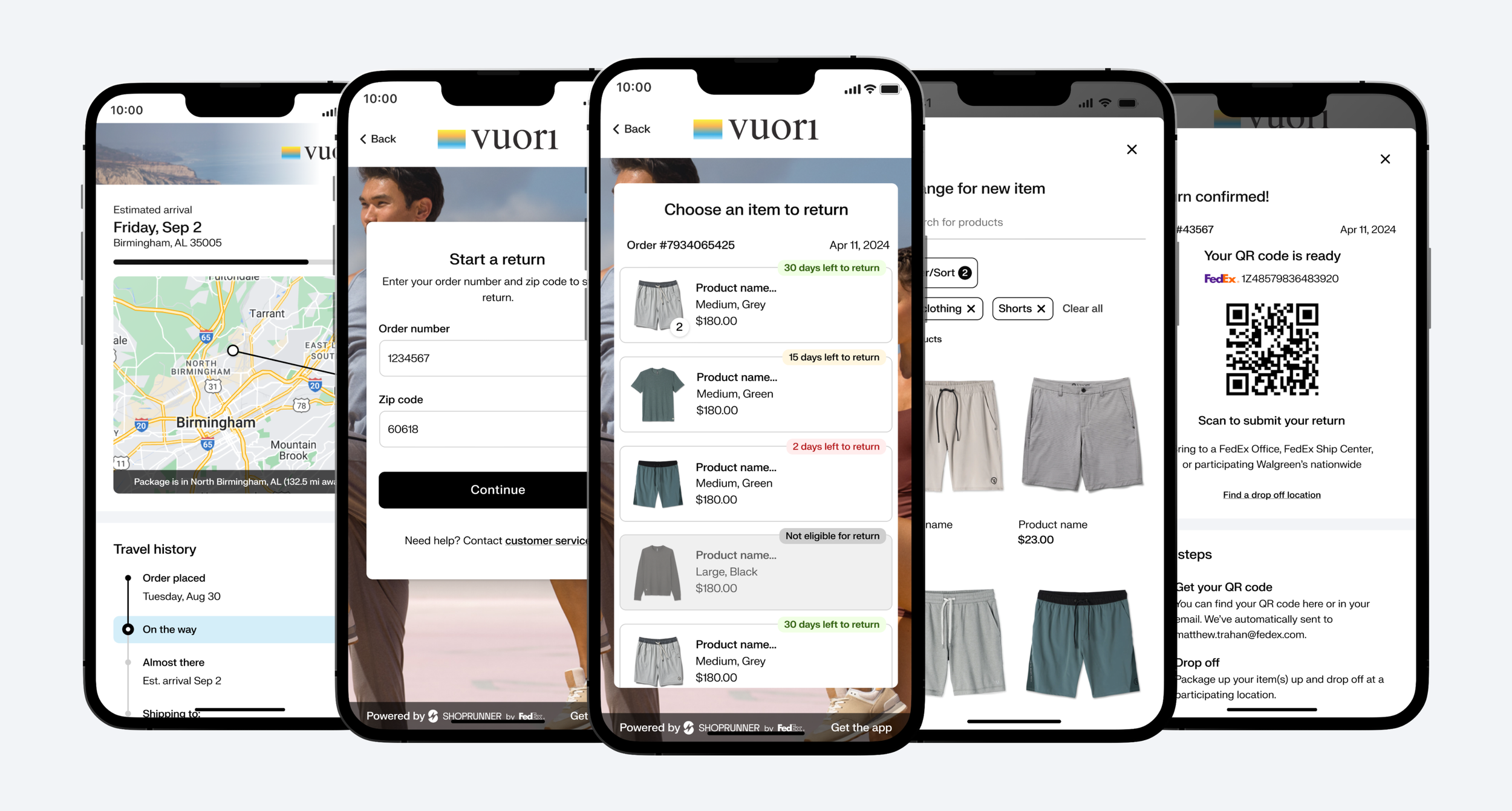
Post-purchase Experience
In January, FedEx publicly announced the development of an end-to-end e-commerce platform called FDX that, among other things, would offer merchants the ability to offer a white-labeled post-purchase (tracking, returns, and exchanges) experience. I was tasked with leading design for that experience.
Team
I collaborated with Product + Design Leadership, UX research, Marketing, Product Management, and Engineering.
Role
I led all design and testing, and collaborated closely product leadership to define the vision for the experience.
Impact
With launch of the FDX platform planned for Fall of ‘24 impact is yet to be determined.
Process
Understand
When FDX was announced, part of the promise was that we would deliver a true end-to-end e-commerce experience, all the way through tracking and returns. Leadership came to the product and design team with a request: create a best-in-class post-purchase experience for merchants and consumers. We needed to do the work to understand what exactly that meant.
Discover
I led a team of two designers and two product managers through a research and discovery exercise that aimed to understand the pain points for both merchants and users in the post-purchase space and understand the competitive landscape. In this phase of the project we spoke to consumers and merchants to go deeper on pain points and needs. The goal was to further define our problem statement and define what it would mean to build an experience that was truly best-in-class.
Explore & Define
Equipped with an understanding of pain points and needs and a more clearly defined understanding of what would constitute a best-in-class experience, we began to explore paths forward. At this stage, which was a collaboration between design, product, engineering and stakeholders from other parts of the business, the idea was to go wide (or divergent) and assess the effort/impact of the possible directions for us to go.
Design, Test, & Develop
With the wealth of insights from our efforts leading up to this point, I began to wireframe out the experience. I strongly believed, based on our conversations with merchants, that the experience would need to be conditional, i.e. answers to questions would impact what questions would be asked next. For this reason, I keyed in on a wizard experience as the foundation for the returns and exchanges flow. I tested both our tracking and returns/exchanges experiences in low-fidelity to gather feedback which would be incorporated into ongoing iterations leading up to dev handoff.